
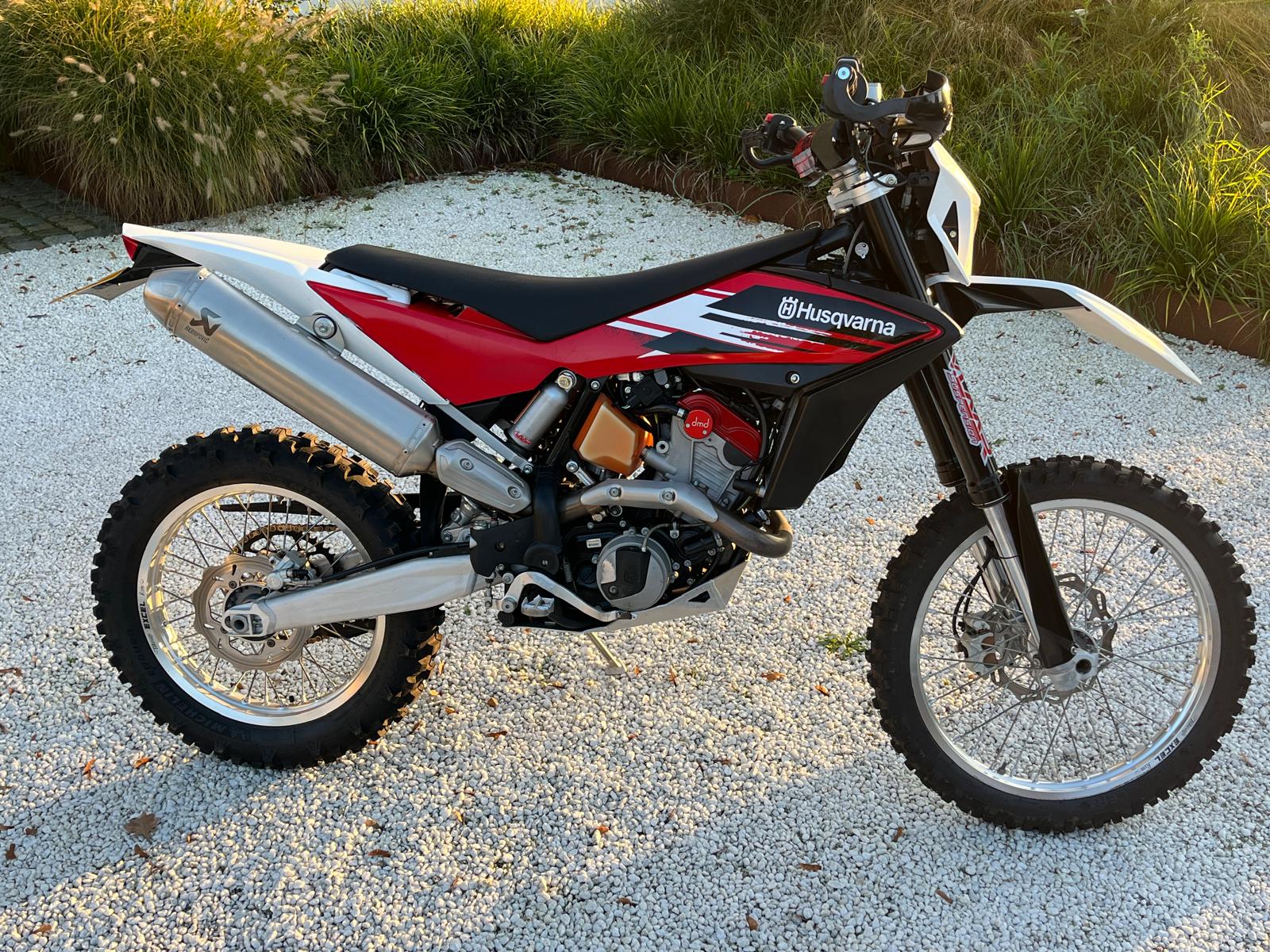
I’ve bought a classic. The Husqvarna TE 511 might not be everyone’s idea of a classic motorcycle, but to me it has all the right ingredients: an ambitious engineering concept, an unusual history, and a character that a small group of enthusiasts truly appreciates.
The story starts with BMW. Having made such a success of big adventure bikes with its boxer-powered GS range, BMW set its sights on the other end of the off-road market: lightweight competition enduros. And, being BMW, it approached the challenge with considerable ambition. The result was the G 450 X, a motorcycle designed around some decidedly unconventional ideas. Around the same time, in 2007, BMW also acquired Husqvarna from the Italian MV Agusta group. That brought together BMW’s engineering resources and a marque with a formidable off-road pedigree.
The most striking feature of the BMW was its coaxial drive arrangement: the front sprocket and the swingarm pivot shared the same axis. This meant that suspension movement did not change the distance between the sprockets, keeping chain tension consistent throughout the travel. An elegant idea, but one that required a very particular engine and chassis layout. The cylinder leaned steeply forward, making room for a straighter intake above the engine. Fuel was carried beneath the seat rather than in the conventional position. The whole motorcycle reflected a willingness to rethink how an enduro should be put together.
As you may have read on my blog, I spent a day riding a G 450 X in South Africa, and it left quite an impression. I was riding with a former local enduro champion, a friend of Alfie Cox, and we tackled some outrageous hill climbs. I could hardly believe what I was managing to ride up. The traction was almost unnerving: the bike just kept finding grip where I expected it to run out. Ever since that day, I’ve had a soft spot for it.
But ambition does not automatically produce a perfectly sorted motorcycle. For all its clever engineering, the BMW had its shortcomings. It was a bold first attempt, with some ideas that deserved further development. That is where the Italian-built Husqvarna TE 449 and TE 511 enter the story. They took the BMW concept and developed it into something distinctly their own.
One particularly useful improvement concerned the coaxial system. Husqvarna used two separate swingarm pivot shafts, making it possible to change the front sprocket without removing the swingarm spindle as on the BMW. The Italians also revised the frame, styling and the suspension with an unusual rear suspension linkage mounted above the swingarm. The Husqvarna’s fuel tank was split into two sections beneath the seat and lower in the chassis, concentrating the weight towards the centre of the motorcycle. It was an unconventional package, but there was a clear purpose behind it.
What emerged was a very special motorcycle. It was also, I think, an underappreciated one. You hardly ever see them, and their place in motorcycle history seems to have slipped past many people. That is precisely why I consider the TE 511 a classic. It reminds me of the Husaberg FE models with their radically tilted engines: distinctive motorcycles that followed their own engineering path and found a devoted following among riders who understood their appeal.
To me, the Husqvarna belongs in that same company. It represents a brief, fascinating period when BMW ambition and Italian enduro experience came together to create something unusual. And now I own one. I’ve already taken it out for its first ride, and I’m pleased to say it hasn’t disappointed.
What strikes me most is how light the 511 feels compared with my Husqvarna 701. It takes off immediately, where the 701 sometimes feels inclined to dig itself into the ground. You notice it on gravel, too. Open the throttle on the 701 and it readily spins up the rear wheel, making it easy to drift. The 511 seems to find far more grip. It hooks up and drives forward, which makes breaking the rear loose—and holding a drift—surprisingly difficult at times. Changing direction is almost shockingly easy. Brake, turn the bars, lean it over, and it’s heading back the other way. It takes so little effort.
The downside is that it feels less stable. In deep, loose sand, the handlebars move around considerably. After that first ride, I can certainly see the appeal of a steering damper. It feels much more necessary here than on the 701. Otherwise, this thing is an absolute weapon.
On the road, though, it is a decidedly Spartan experience compared with the 701. The seat is hard as a plank, there is no wind protection, and the gearing is incredibly short. The engine isn’t particularly happy at a steady throttle, either. Every now and then, it seems to stumble slightly, as though it would much rather be accelerating than cruising. Holding a constant road speed clearly isn’t its favourite occupation.
Mine has an Akrapovič exhaust system, supplied as an original accessory, together with a dedicated performance map. With that setup, I understand it should produce somewhere around 50 to 55 horsepower at the crank. It certainly feels believable: there is some serious punch in this little motorcycle.
One reason I bought it is that I’ve been riding with my son over the past few months. He has only recently passed his motorcycle test and rides a Beta 125. In dry conditions, my big 701 with its rally kit can keep up perfectly well, but the pairing sometimes feels as though he’s driving a buggy while I’m following in a Range Rover.
The 511 makes us a much better match. I still have considerably more power, but now we’re both riding what are essentially dirt bikes with indicators. It makes for a wonderfully entertaining combination.
And then there is the simplest reason of all: I’ve wanted to own one of these for years.
Now I finally do, and that makes me happy.

